Best Supplement For Memory12 Vitamins for Memory and What the Evidence Actually Supports
12 Vitamins for Memory and What the Evidence Actually Supports
Some links on this site are affiliate links: if you buy through one, the site may earn a commission at no extra cost to you. More about this.
If you are comparing brain supplements, the question that matters is not whether a vitamin appears on the label but whether the evidence applies to someone like you. Some formulas stack vitamins at doses that were never tested against memory outcomes, so the label alone tells you little.
This guide covers 12 vitamins for memory, each one judged by the strength and consistency of human trial data. The list draws on the vitamins most often named in memory products and on the research that has tested them directly. Each entry notes where the evidence is solid, where it is thin, and where it is absent.
The same standard applies to products that bundle several ingredients together. Phytomem One, which is sold through its own sales page, lists a mix of botanicals and vitamins, and the vendor says it is a 10-in-1 formula for mental clarity and recall. Those are the vendor's claims. The ingredient list does not tell you how much of each component is included, and the reviewers covered later on this page disagree about how much they could attribute to it.
Let's dive in.
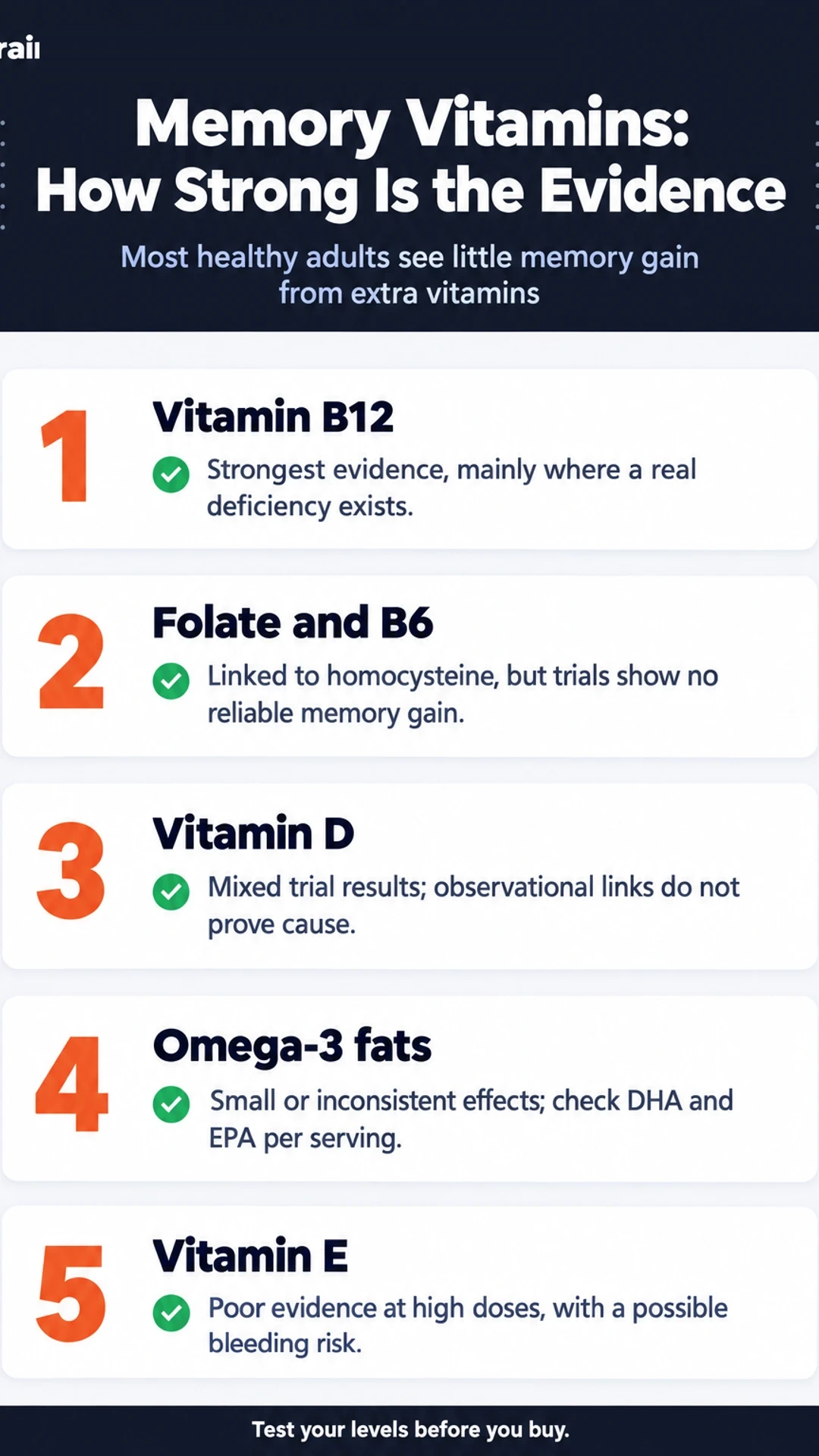
Evidence strength for each vitamin
Swipe sideways to see more columns.
| Vitamin | Evidence for memory | Key limit |
|---|---|---|
| Vitamin B12 | Strongest; helps with deficiency | Little gain in normal levels |
| Folate (B9) | Linked to homocysteine | Not reliably better memory in trials |
| Vitamin B6 | Plausible mechanism, thin data | Too much risks nerve damage |
| Vitamin D | Mixed trial results | Observational links only |
| Omega-3 (DHA/EPA) | Small or inconsistent effects | Check DHA and EPA per serving |
| Vitamin E | Poor for high doses | Possible bleeding risk |
A closer look at each
Vitamin B12: This is the most consistently studied memory vitamin, and the evidence is strongest where a real deficiency exists. Low B12 is linked to cognitive problems, and treating a confirmed deficiency often helps. In people with normal levels, extra B12 has not shown a clear benefit for memory. Check serum B12 before buying. Most adults over 50 are better served by a blood test than by a high-dose guess.
Folate (vitamin B9): Folate works alongside B12 in the pathway that clears homocysteine, and higher homocysteine is associated with cognitive decline. The catch is that lowering homocysteine with B vitamins has not reliably translated into better memory in trials. Folate is essential for many body functions. The practical question is whether your diet or a standard formula already covers your intake, not whether a high dose will sharpen recall.
Vitamin B6: B6 is usually sold in the B complex trio with B12 and folate, but its evidence base for memory is narrower than for the other two. It takes part in neurotransmitter synthesis, which is a plausible mechanism, yet clinical data showing memory gains are thin. Very high B6 intake over long periods can cause nerve damage, so more is not better here. Read the per-dose amount on any B blend rather than assuming a higher number helps.
Vitamin D: Observational studies have linked low vitamin D with poorer cognition and dementia risk, but those studies cannot show that low vitamin D causes the decline. Randomized trials giving vitamin D to older adults have produced mixed results for memory and thinking, with no consistent benefit overall. Testing your 25-hydroxyvitamin D level tells you more than guessing at a dose. Vitamin D is best viewed as a general health nutrient rather than a memory fix.
Omega-3 fatty acids (DHA and EPA): Omega-3s are not a vitamin, but DHA is a major structural fat in brain tissue, which is why they appear in nearly every memory product. Trials in healthy older adults have generally shown small or inconsistent effects on memory, while people with low baseline intake or certain conditions may respond differently. Check the label for DHA and EPA in milligrams per serving, since many products list only total fish oil. Look for third-party testing for oxidation and contaminants.
Vitamin E: Vitamin E is often promoted for memory because of its antioxidant role in protecting cell membranes. The trial record is poor for high-dose supplementation, and large doses have been associated with increased risk of bleeding and, in some analyses, higher mortality. Some trials of vitamin E in people with mild cognitive impairment showed a modest slowing of decline at high doses, but those findings have not been reliably replicated. Diet sources such as nuts and seeds are the safer route, and high-dose capsules deserve caution.
Vitamin C: Vitamin C is often included in brain blends because of its antioxidant role, but direct evidence for memory in healthy adults is thin. Most of the interest comes from observational links between blood levels and cognition, which do not show cause. Low dietary intake is the realistic concern, and a standard multivitamin already supplies the recommended daily amount of 75 to 90 mg for most adults.
Magnesium: Magnesium matters for nerve signalling and shows up in many brain formulas. Some trials of magnesium L-threonate have reported memory gains in older adults. The studies are small and mostly short, and the form matters, since many common magnesium salts cross the blood-brain barrier poorly. Check the elemental magnesium per serving, not just the compound weight.
What the "dementia cut by 40 percent" headlines usually mean: These headlines typically report a relative risk reduction from an observational cohort or a subgroup analysis, while the absolute difference may be a few percentage points. Look for whether the finding came from a randomised trial, what the baseline risk was, and whether the supplement was the exposure or just one of many correlated habits. A relative figure without a baseline tells you little.
Blend and proprietary-formula labels: A 10-ingredient proprietary blend often lists ingredients without per-ingredient amounts, so you cannot tell whether any component is present at a dose studied in research. Compare each ingredient against the dose used in trials, and treat unlisted amounts as unknown rather than adequate. Look for full disclosure, third-party testing marks, and whether the ingredients have independent evidence on their own.
Who should talk to a doctor first: Older adults, anyone with kidney or liver disease, pregnant or breastfeeding women, and anyone taking anticoagulants, antidiabetic drugs, blood pressure medication or antidepressants should speak with a clinician before starting. Several botanicals in common blends, such as berberine and some citrus or cinnamon extracts, can interact with glucose-lowering or blood-thinning drugs. Bring the full ingredient list, not just the product name.
A checklist for comparing memory supplements: Check whether each ingredient has trial evidence for memory at the dose listed, whether amounts per ingredient are disclosed, whether third-party testing confirms label accuracy, and whether any interaction with your current medication is documented. Note the claim type, distinguishing vendor statements from independent findings. Apply the same questions to every product in this hub so the comparisons stay consistent.
Frequently asked questions
What do Japanese eat to prevent dementia?
No single Japanese food prevents dementia, and no study has shown that. Researchers who look at traditional Japanese diets point to a pattern: plenty of fish, soy, vegetables, seaweed, green tea and rice eaten alongside relatively little red meat and sugar. These are observational associations, so they suggest a direction for diet research rather than a proven cause.
What does Mayo Clinic recommend for memory?
Mayo Clinic's memory advice centers on habits rather than pills: regular physical activity, good sleep, managing blood pressure, blood sugar and cholesterol, staying socially and mentally active, and limiting alcohol. It also advises talking with a doctor about memory changes, since some causes such as thyroid problems, medication effects or vitamin B12 deficiency are treatable.
Is there a vitamin that cuts dementia risk by 40 percent?
No vitamin has been shown to cut dementia risk by 40 percent in a reliable trial. Figures like this usually come from small subgroup analyses, observational data or misread results. Large randomized trials of common vitamins such as B vitamins and vitamin E have generally not shown a clear reduction in dementia, so treat any single headline percentage with suspicion.
What is the strongest cognitive enhancer?
There is no agreed strongest cognitive enhancer. Most supplements have modest or unproven effects on healthy adults, and the strongest evidence for protecting memory belongs to basics like exercise, sleep, blood pressure control and treating hearing loss. Prescription drugs for dementia exist but are for diagnosed disease and are not general enhancers.
Do vitamins for memory actually work?
Vitamins help memory mainly when a deficiency is present. Correcting low vitamin B12 or folate can improve cognition, while taking extra doses in people who already have enough has not shown consistent benefit in trials. The useful question is whether you are deficient, which a blood test can answer, rather than whether a vitamin might help in general.
Wrapping up
That covers the twelve vitamins for memory, and the evidence is strongest for only a few of them, mainly where a true deficiency exists.
Which one will you check first with your doctor, or did I leave out one you have seen in a product label?
If you are comparing options after reading this, Visit the official site to read the Phytomem One sales page, which describes its formula as a 10-in-1 blend built for mental clarity and recall.