Best Supplement For MemoryDo Brain Supplements Work? How to Judge the Evidence Behind the Claims
Do Brain Supplements Work? How to Judge the Evidence Behind the Claims
Some links on this site are affiliate links: if you buy through one, the site may earn a commission at no extra cost to you. More about this.
If you are searching whether brain supplements work, you have probably noticed how confident the marketing is and how thin the proof often looks once you dig in. The label lists a dozen botanicals, the sales page promises sharper recall, and the trial behind it is either absent or small. That gap between claim and evidence is the real problem, and it is worth sorting out before you spend money or change anything about your health.
This article takes a practical approach. It separates what a vendor says from what a published trial measured, and shows you how to tell the two apart. Along the way it looks at one product, Phytomem One, using what its sales page claims alongside two hands-on YouTube reviews, and notes where those reviews support a conclusion and where they do not.
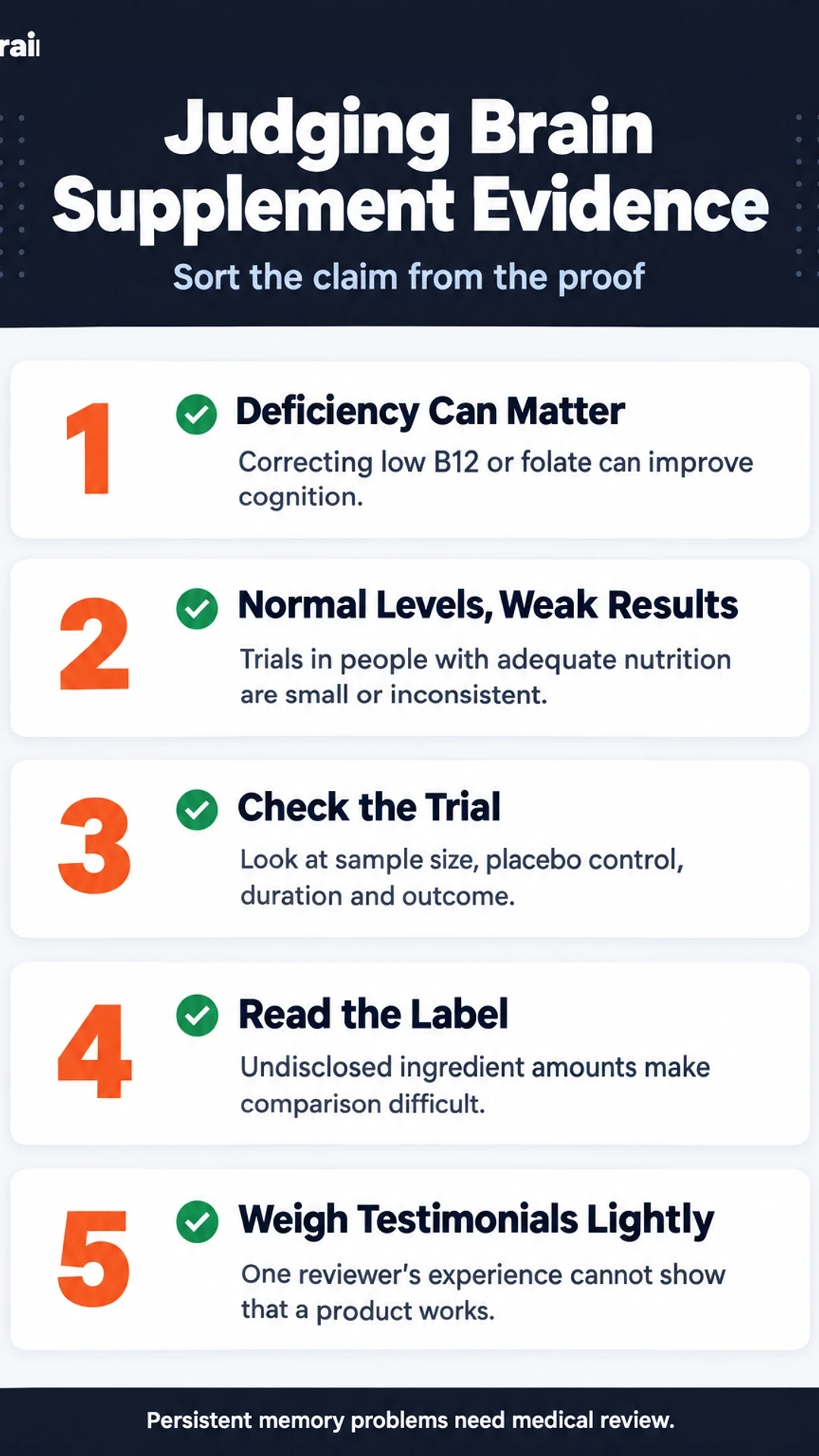
- Deficiency versus general use: why correcting a documented shortage is a different question from taking a supplement to improve a normal brain.
- Reading a vendor claim: how to spot language that describes an ingredient's lab activity rather than a result in people.
- Judging a trial: sample size, control groups, dosing, duration, and whether the outcome measured was memory or only a proxy.
- Ingredient transparency: what it means when a formula does not disclose the amount of each ingredient, and why that matters for comparison.
- Testimonials and personal reviews: what a single reviewer's experience can and cannot tell you.
- Where Phytomem One fits: how its claims hold up against the evidence, and how it compares with other options in this hub.
What Brain Supplements Can and Cannot Do
Before you compare any product, it helps to settle what supplements can realistically do. The question is less "do brain supplements work?" and more "for whom, and for which problem?"
The strongest case for supplementation is correcting a deficiency that is already impairing cognition. Vitamin B12 deficiency is the classic example. It can cause memory problems, confusion and slowed thinking, and replacing it often improves those symptoms. Folate and vitamin B6 play a role in keeping homocysteine, an amino acid, in check. Elevated homocysteine levels have been linked to cognitive decline and cardiovascular risk, and the evidence for lowering it with B vitamins is more mixed than marketing suggests. The point is that the benefit comes from fixing a shortfall, not from pushing a normal system beyond its baseline.
Enhancement is a much weaker story. In people with adequate nutrition, taking extra vitamins or botanical extracts to sharpen memory or focus has a thin and inconsistent record in trials. Many studies are small, short, or funded by the company selling the product, and results often fail to replicate. If your intake is already sufficient, an additional capsule is unlikely to add much.
A few boundaries to keep in view:
- Supplements have not been shown to reverse established dementia or memory loss.
- A supplement that "supports" brain health is not the same as one that treats a diagnosed condition.
- Persistent memory problems deserve a medical workup, since treatable causes such as thyroid disorders, medication side effects, sleep apnea and depression are common.
Mayo Clinic's general guidance centers on lifestyle factors such as physical activity, sleep, blood pressure and blood sugar control, and social engagement, along with a review of your medications and a search for underlying causes. Supplements sit well behind those priorities.
Where supplements help and where they do not
Swipe sideways to see more columns.
| Situation | What the evidence supports |
|---|---|
| Documented B12 or folate deficiency | Correcting the shortfall can improve cognition |
| Normal nutrient levels | Weak or inconsistent trial results |
| Established dementia or memory loss | Not supported by established evidence |
| Persistent memory problems | Medical workup for treatable causes |
The B-Vitamin Evidence: B6, B12, Folate and Homocysteine
Homocysteine is an amino acid that sits in a recycling loop. Remethylation turns it back into methionine using folate and vitamin B12, and the transsulfuration route clears it using vitamin B6. When any of these steps stalls, homocysteine rises. Elevated homocysteine has been linked to vascular disease and, in observational work, to cognitive decline, which is why the B-vitamins drew so much attention for brain health.
Keep two kinds of evidence apart. Observational cohorts show that people with higher homocysteine or lower B-vitamin status tend to have more dementia or stroke. That tells you about association, not cause. Randomized trials test whether giving the vitamins changes outcomes. Several of the large ones, including the VITACOG trial in older adults with mild cognitive impairment, reported that homocysteine fell with B-vitamin treatment but found little or no effect on cognition in people who were not already deficient. Researchers such as Jacques Rosenberg and colleagues in nutrition science have argued that the effect shows up mainly where baseline levels are low.
That is the point that matters most for B12 and dementia. The signal is strongest in people with actual deficiency, which is more common in older adults with reduced stomach acid or on long-term acid suppressants. For someone with adequate levels, general supplementation has not been shown to slow dementia in trials.
The cardiovascular picture follows the same logic. Lowering homocysteine has not reliably reduced heart attack or stroke in people with normal levels, and benefit appears where elevated homocysteine or deficiency is present at baseline. Get levels checked before assuming you need them.
Reading Trials: What a Credible Study Looks Like
When a brain supplement page cites research, start by asking how much the cited trial can actually tell you. Most of the time the answer is less than the marketing implies. Check the basics first.
How big, how long, and who was in it? Small trials produce unstable results, and a short follow-up rarely captures anything about cognitive decline or dementia risk, which develop over years. Look at the population too. A trial in people with a documented deficiency, such as low folate or elevated homocysteine, may show effects that do not transfer to healthy adults with normal levels. If baseline levels were not reported, the study cannot tell you whether the product helped anyone who needed it.
What was the comparison? Look for a placebo arm, pre-registered endpoints, and objective cognitive testing. Self-reported improvement in memory or focus is one of the weakest signals in this field, because expectation effects are large. A study that reports only questionnaire scores deserves less weight than one that uses standardized tests.
Who paid for it, and what exactly was tested? Industry funding does not make a trial worthless, but it does mean you should check whether the product in the study matches the one being sold, including dose and formulation. A trial of a single ingredient at a research dose says little about a multi-ingredient tablet at a different dose.
Be wary of two common patterns. Subgroup findings, where a result appears only in women over 65 or only in people with one genotype, are often chance. A headline like "reduced risk by 40%" may describe a shift from 2 cases in 100 to 1 in 100. Always ask for the absolute numbers behind any percentage.
Evidence types compared
Swipe sideways to see more columns.
| Evidence type | What it shows | Limitation |
|---|---|---|
| Observational cohort | Association between B-vitamin status and outcomes | Does not show cause |
| Randomized trial | Effect of giving the vitamins | Results depend on baseline levels |
| Self-reported improvement | How someone feels about their memory | Expectation effects are large |
| Vendor sales page | What the seller claims | Not evidence of benefit |
Judging a Vendor's Claims and Ingredient List
The first skill is separating what a sales page says from what has been tested. A product page is marketing. It can describe the formula, the sourcing and the intended benefit, but none of that tells you the product works. When Phytomem One's sales page calls it a "10-in-1 neuro-essential formula built for lasting mental clarity, recall, and resilience," that is the vendor's claim, and it should be read as one. Attribute it that way when you write it down: "the vendor says" or "according to the sales page," not "this improves recall."
Start with the ingredient list and ask three questions of each line:
- Is the amount per ingredient disclosed?
- Is there a published trial using that ingredient at that dose, in humans, for a cognitive outcome?
- Does that trial match the population and the product form?
Dose is where many of these pages fall apart. An ingredient appearing on a label tells you little if it is buried in a proprietary blend, because the amount is what the trials tested. A herb that showed an effect at 300 mg may do nothing at 20 mg. Phytomem One's sales page lists saffron extract, berberine HCl, Ceylon cinnamon bark, banaba leaf and several other extracts, but it gives no dose per ingredient, and I could not find a trial of the finished formula in the material available to me. Without doses, you cannot match the product to any study, so you are left trusting the vendor's framing.
Two other points on the page are easy to misread. The organic and non-GMO statements describe sourcing and handling, not cognitive benefit. They may matter to you for other reasons, but they say nothing about memory. Likewise, the "stimulant-free" claim describes what is absent, not what the product does.
Reviewers' accounts add context but not proof. One reviewer, Top Class Documentaries, took the product daily for 60 days and reported better focus and easier recall, yet gave it four out of five stars because the amount of each ingredient is not disclosed. That reservation is the same one this section keeps returning to. Personal observation is worth noting, and it is not a trial.
What Hands-On Reviews Can and Cannot Tell You
Hands-on reviews are a useful starting point, but they answer a narrower question than most people assume. They tell you what one person noticed while taking a product. They do not tell you whether the product caused what they noticed.
Take the 60-day test run by Top Class Documentaries. The reviewer, a 54-year-old taking one capsule each morning with breakfast, reported better focus during business meetings and easier recall of phone numbers, names and addresses. They rated the product four out of five stars, holding back one star because the exact amount of each ingredient is not disclosed. That disclosure gap matters more than the star rating. You cannot check a dose you cannot see, and you cannot compare the formula with ingredients studied at known amounts. The reviewer was also clear that these were personal observations, not proof that others would see the same results.
As coisas de Deus takes a more cautious line. The reviewer noted that results vary with sleep, nutrition, stress and activity, and warned that imitation products are being sold online, so the source matters as much as the label.
Why can't a few good experiences settle it? Memory and attention fluctuate from week to week, and a person who starts a new routine often changes other things at the same time: they sleep better, eat differently, pay closer attention to their own performance. Expectation alone can shift how you rate your recall. Placebo responses are real in cognitive self-reports, and a single reviewer has no control group to separate a supplement effect from any of these. A controlled trial with a placebo arm, measured outcomes and a defined population is the only design that can make that separation.
What to look for instead:
- Full ingredient amounts, not proprietary blends
- Trials on the same ingredient, at a comparable dose, in people like you
- Outcome measures beyond self-report
- Clear statements of who should avoid the product
Safety, Medication Checks and When to Ask a Clinician
Before you weigh one product against another, check whether it is safe to take at all. Many brain supplements combine botanicals and nutrients that interact with prescription drugs, and the risk is highest for older adults on several medications. Ask your doctor or pharmacist to review the full ingredient list, not just the product name. Pay particular attention to blood thinners such as warfarin, where some botanicals and some high-dose supplements can change bleeding risk, and to diabetes drugs, since several ingredients in this category are marketed for blood sugar and can add to the effect of your medication.
Should I check my B12 or folate levels first?
Possibly, and it is worth asking before you start. A vitamin B12 deficiency can cause cognitive symptoms, and so can low folate. Deficiency in either is treatable, but supplementing without knowing your levels can mask a problem or, in the case of folic acid, obscure a B12 deficiency. A simple blood test, with B12 and folate measured together, tells you whether a supplement is addressing a real gap. Elevated homocysteine is sometimes checked alongside these, though its link to cognitive decline is still debated among researchers.
When does memory trouble mean a medical visit, not a supplement?
Any new or worsening memory problem should prompt a medical evaluation first. Dementia, thyroid disorders, medication side effects, sleep apnea and depression can all look like memory loss, and some are treatable. Do not start a product and wait to see whether symptoms improve. Bring a clear account of when the problem started and how it has changed.
Once a clinician has checked your medications and your levels, the rest of this hub can help you compare options. Read the comparison of brain supplements and the safety checks for seniors before you choose anything.
Frequently asked questions
What does Mayo Clinic recommend for memory?
Mayo Clinic's general guidance centers on habits rather than pills: regular physical activity, good sleep, managing blood pressure and blood sugar, not smoking, limiting alcohol, and staying socially and mentally active. Memory concerns that are new, worsening, or interfering with daily life should be checked by a clinician, because some causes are treatable.
What are the three ingredients to reverse memory loss?
No ingredient trio has been shown to reverse memory loss in people. Claims that name three ingredients usually come from marketing, not trial data. Memory loss linked to conditions such as thyroid problems, vitamin B12 deficiency, or medication side effects may improve once the cause is treated, so testing for those is more useful than searching for a set of ingredients.
How to improve dementia?
Dementia is a progressive condition and no supplement reverses it. Some medications can modestly slow symptoms in certain types, and management focuses on controlling blood pressure, treating depression and sleep problems, staying physically active, and adapting the home and daily routine. A neurologist, geriatrician, or memory clinic can outline options for a specific diagnosis.
Do any brain supplements work?
Some have modest support in trials, but the results are mixed and usually limited to specific groups or outcomes. Omega-3 fats, for example, have been studied extensively with inconsistent effects on memory in healthy adults. Judging a product means checking whether the exact formulation and dose were tested in independent, peer-reviewed trials, not just whether individual ingredients appear in the literature.
Are brain supplements worth the money?
For most people, the answer depends on whether the product's specific ingredients and doses match what was actually studied. A proprietary blend with undisclosed amounts makes that check hard. Reasonable alternatives include a diet rich in vegetables, fish, nuts, and legumes, plus a conversation with a clinician about any measurable deficiency before spending on supplements.
Wrapping up
Brain supplement claims rarely hold up when you trace them back to the exact formula and dose used in published trials, so judge the evidence before the marketing. Most memory complaints are better addressed through sleep, activity, blood pressure control, and a medical check for treatable causes. If you have weighed the evidence and want to look at one option closely, what do you check first before buying a supplement? Share your approach in the comments.
Visit the official site to read the full ingredient list and product details for Phytomem One, then compare them against the trial evidence you have already reviewed.