Best Supplement For Memory12 Best Memory Supplements for Women Over 50, Compared by Ingredient and Safety
12 Best Memory Supplements for Women Over 50, Compared by Ingredient and Safety
Some links on this site are affiliate links: if you buy through one, the site may earn a commission at no extra cost to you. More about this.
Based on the product's documentation and what users report, not our own testing. Last checked: 14 November 2026.
If you are comparing options, you are likely trying to answer two questions at once: what is actually in the bottle, and whether the claims on the label hold up. This page covers memory supplements, compared by ingredient profile and safety considerations rather than by marketing language. Based on the product's documentation and what users report, not our own testing.
Each option was chosen for having a named, identifiable ingredient set and a product page or label that lists what is inside. Where a product's amounts are not disclosed, we say so.
One product gets closer attention in this roundup. Phytomem One is a 10-ingredient tablet that its sales page describes as a neuro-essential formula for mental clarity, recall and resilience. According to the sales page, the formula includes saffron extract, fucoxanthin, fucoidan, oleuropein, berberine HCl, Ceylon cinnamon bark, corosolic acid from banaba leaf, kudzu flower extract and Morosil. The vendor says it is non-GMO, stimulant-free and handled under the USDA National Organic Program. Based on the product's documentation and what users report, not our own testing, we describe what is claimed and what independent reviewers have noted, including that ingredient amounts are not disclosed.
Let's dive in.
Memory supplements at a glance
Swipe sideways to see more columns.
| Option | Key ingredients | Dose or amount stated | Main safety note | Evidence noted |
|---|---|---|---|---|
| Omega-3 Fatty Acid Supplements | DHA and EPA | Not stated | Check DHA and EPA per dose | Mixed results |
| Ginkgo Biloba | Ginkgo biloba extract | Not stated | Interacts with blood thinners | Large trials show no clear benefit |
| B Vitamins (B6, B12, Folate) | B6, B12, folate | Not stated | Test before high doses | Helps when deficient |
| Vitamin D | Vitamin D | Dose not stated in this review | Blood test shows if needed | Weak in people with normal levels |
| Vitamin E | Alpha-tocopherol | Dose not stated in this review | Bleeding risk at high doses | Mixed results |
| Curcumin (Turmeric Extract) | Curcumin, often with piperine | Not stated | Affects clotting and some medications | Small, short human trials |
| Bacopa Monnieri | Bacosides | Dose not stated in this review | Slow onset, stomach upset | Not stated |
| Phosphatidylserine | Phospholipid, often with omega-3 | From about 100 mg per serving | Check source and dose | Not stated |
A closer look at each
Omega-3 Fatty Acid Supplements: Omega-3 fatty acids, mainly DHA and EPA, are among the most frequently cited ingredients for brain health, and the NCCIH summary of supplements studied for cognition includes them. The evidence is mixed: some trials show small benefits in people with mild decline, while larger trials in healthy older adults have not shown a clear memory benefit. Check the DHA and EPA amounts per dose, since many labels list total fish oil instead.
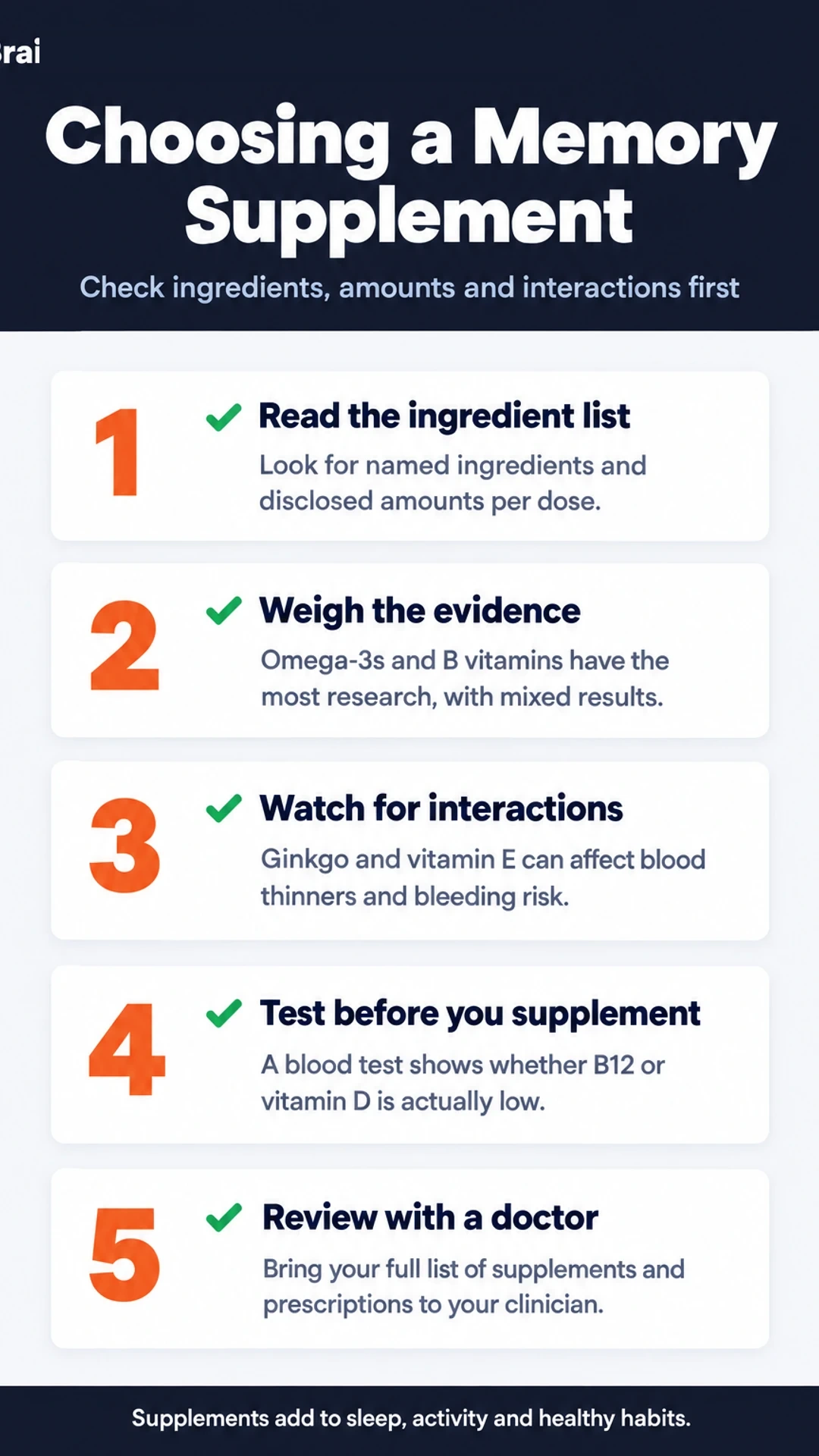
Ginkgo Biloba: Ginkgo biloba extract appears in most top-ranking supplement lists and on several retail listings for memory products. The NCCIH notes that large trials, including a well-known study in older adults, did not show that ginkgo prevents dementia or improves memory in healthy people. It also interacts with blood thinners such as warfarin and aspirin, so anyone on those medications should speak with a clinician first.
B Vitamins (B6, B12, Folate): B6, B12 and folate matter for nerve function and for lowering homocysteine, a compound linked to vascular and cognitive risk. Absorption of B12 tends to fall with age because of reduced stomach acid, so deficiency is more common in older women. Testing before supplementing is more useful than taking high doses blindly, because excess folate can mask a B12 deficiency.
Vitamin D: Vitamin D is a frequent item on senior brain health lists, and deficiency is common in older women, particularly after menopause and in people who spend little time outdoors. The evidence that supplementation improves memory in people with normal vitamin D levels is weak. The right supplemental dose for an adult varies, and a blood test can show whether supplementation is needed at all.
Vitamin E: The NCCIH summary of cognition-related supplements lists vitamin E, usually as alpha-tocopherol. Trials in people with existing cognitive impairment have produced mixed results, and high doses of vitamin E have been linked to a higher risk of bleeding. Food sources such as nuts, seeds and vegetable oils provide it without the same risk.
Curcumin (Turmeric Extract): Curcumin appears in the NCCIH summary and on the healthyvoyager.com list of memory supplements. Turmeric itself contains only a few percent curcumin, so extracts are standardised to higher amounts, and the piperine added to many products is there to improve absorption. Human memory trials are small and short, and curcumin can affect blood clotting and some medications, so check with a clinician if you take anticoagulants.
Bacopa Monnieri: Bacopa is a traditional Ayurvedic herb that appears in many memory-focused formulas and is named on the Vital Nutritive snippet and several Amazon listings. Its standard extract is usually standardized to bacosides. The dose used in studies is not stated in this review. Slow onset, often taking several weeks, and gastrointestinal upset are the points worth checking on the label.
Phosphatidylserine: Phosphatidylserine is a phospholipid that shows up in the Amazon results and in many memory blends, often alongside omega-3 fatty acids. Labels usually list it in amounts from about 100 mg per serving, and sources differ, with some derived from soy and others from sunflower lecithin. Check the source and dose, since a small amount in a multi-ingredient blend tells you little about its effect.
Phytomem One: Based on the product's documentation and what users report, not our own testing. The vendor says Phytomem One is a 10-in-1 formula with saffron extract, fucoxanthin, fucoidan, oleuropein, berberine HCl, Ceylon cinnamon bark, corosolic acid (banaba leaf), kudzu flower extract and Morosil. The sales page lists one capsule daily with food, a 60-day money back guarantee and a purchase only through its own page. Ingredient amounts are not disclosed, and one reviewer found this the main gap. Users' reports of better focus and recall are personal and vary with sleep, stress and overall lifestyle.
Neuriva Brain Supplement: Neuriva is named in the Amazon listing and in several People Also Ask questions, and it is one of the better-known brain supplements sold for everyday cognitive support. Its marketing centers on a proprietary blend and vitamins, but independent verification of its memory claims is limited. Read the full supplement facts panel, check for vitamin or mineral overlap with your other products, and confirm dosing with a clinician if you take prescription medication.
Lion's Mane Mushroom: Lion's mane is a culinary and medicinal fungus that appears in several Amazon nootropic blends. Human studies are small and short, and label doses vary widely between products. Look for a fruiting body extract rather than mycelium grown on grain, and note that mushroom-derived products can cause digestive upset or allergic reactions in some people.
Lifestyle Factors That Outweigh Supplements: Consumer Reports and the terrabella page both stress that memory depends on sleep, physical activity, blood pressure control, hearing, social contact and stress management. A supplement is a small variable next to these, and the reviewer in one video noted that results depend on consistency, nutrition, sleep, activity, stress and overall lifestyle. Treat any supplement as an addition to these habits, not a substitute, and bring your full list of supplements and medications to your doctor, especially for vitamins and dietary products that may interact with prescriptions.
Frequently asked questions
What is the best vitamin for seniors for memory?
No single vitamin is proven best for memory across older adults. Vitamin B12 matters most when someone is deficient, and deficiency is more common with age because absorption drops. Folate and vitamin D are also checked when intake is low. A blood test is the practical starting point, since correcting a real deficiency is where the clearest benefit has been shown.
Does Prevagen or Neuriva actually work?
The evidence for both is weaker than their marketing suggests. Prevagen's main claims have been challenged by regulators, and its maker agreed to a settlement over unsupported memory claims. Neuriva's own studies have been small and mostly short. Neither product has shown a clear, reproducible memory benefit in large, independent trials, so set expectations low and check the ingredient list.
What does Mayo Clinic recommend for memory?
Mayo Clinic's guidance centres on lifestyle: regular physical activity, good sleep, managing blood pressure, blood sugar and cholesterol, limiting alcohol, staying socially and mentally active, and treating hearing loss and depression. It does not recommend memory supplements as a general fix. It advises talking with a doctor before starting any supplement, especially if you take prescription medicines.
What is the most powerful herb for memory?
No herb has been shown to be the most powerful for memory. Ginkgo biloba is the most studied, but large trials have not confirmed a meaningful benefit for preventing memory decline. Bacopa has some small trial data, usually with weeks of use needed before any effect. Herbs can interact with blood thinners and other drugs, so the safety check matters more than ranking them by strength.
How do I check a memory supplement for medication overlap?
Start by reading the full ingredient list and the amount of each ingredient, then compare it against your current prescriptions. Berberine can affect blood sugar and some drug levels, and fucoidan and ginkgo can increase bleeding risk with anticoagulants. Bring the label and your medication list to your pharmacist or doctor before you start, and stop and call them if you notice new symptoms.
Wrapping up
That is the full set of 12 options, compared by ingredient and safety. Before you commit to any one of them, check the ingredient amounts and your current medicines against the label. Which of the 12 will you try first, or is there one I missed? Tell me in the comments.
If you want to look at Phytomem One's own offer in detail, Visit the official site to read the vendor's sales page, plan prices and refund terms before deciding.