Best Supplement For MemoryBest Brain Supplements for Seniors: Safety Checks First
Best Brain Supplements for Seniors: Safety Checks First
Some links on this site are affiliate links: if you buy through one, the site may earn a commission at no extra cost to you. More about this.
Based on the product's documentation and what users report, not our own testing. Last checked: 14 November 2026.
You have probably seen similar claims about memory and focus, and the product's own page describes its goal as gradual daily support rather than a quick boost. Based on the product's documentation and what users report, not our own testing. The labels are crowded, the doses are often missing, and the ingredient names mean little unless you know what they do and who they might affect.
This page starts with safety. We set out how to check each product against your own medicines and conditions, then look at what the vendor says about its formula and what other people have reported, so you can judge the claims for yourself. Based on the product's documentation and what users report, not our own testing, we compare one option in detail, Phytomem One, and explain which points need a clinician's input. Other pages on this site cover focus, natural options, and the research on memory supplements.
Start With a Medication and Condition Check
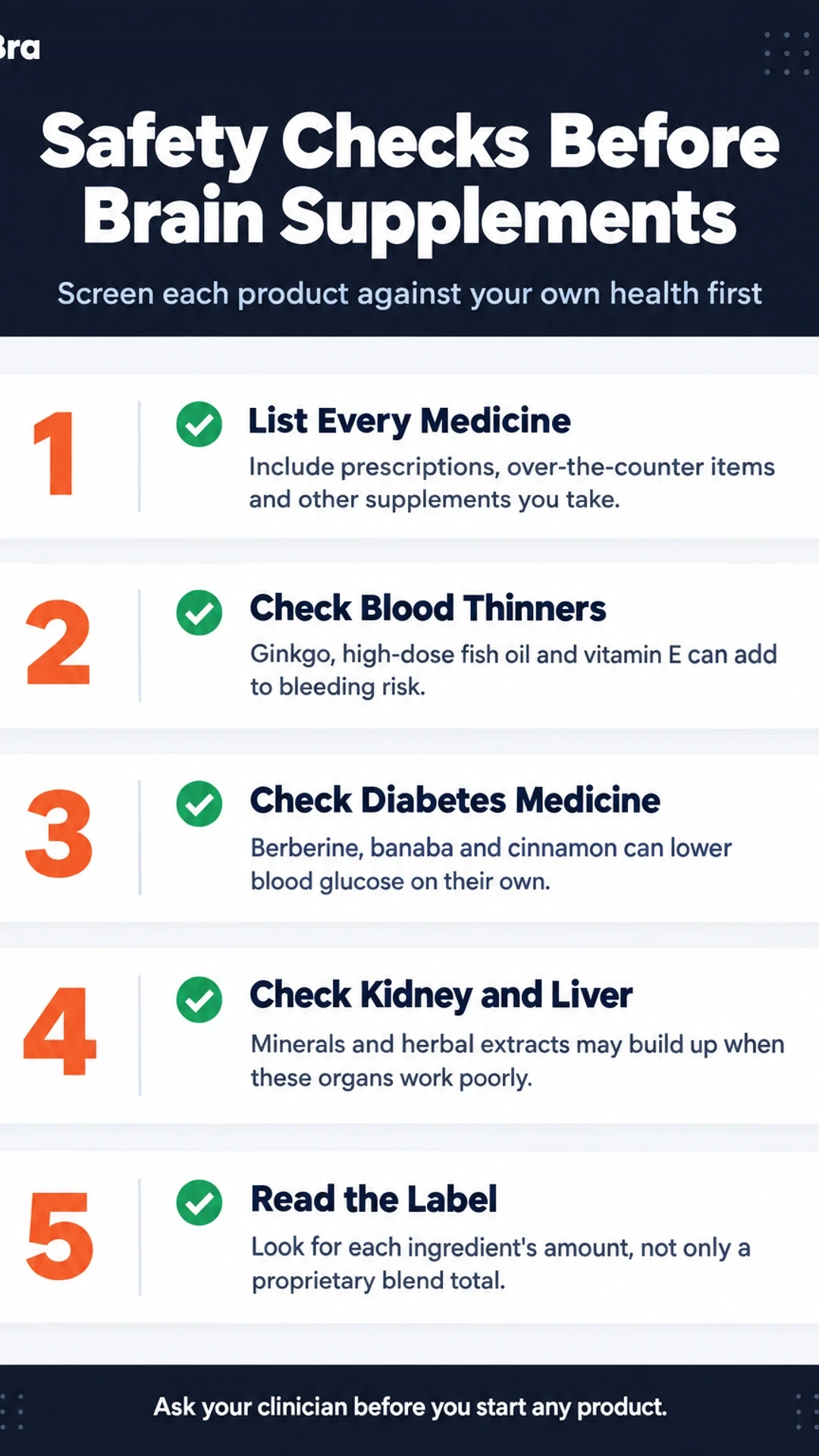
Before you compare any brain supplement, run a safety screen against your own medication list and health history. Many of the ingredients that show up in these products are active compounds, not inert filler, and several of them interact with drugs that older adults take every day. Bring the full list to your clinician, including over-the-counter products and other supplements.
Are you on a blood thinner?
If you take warfarin or a similar anticoagulant, be cautious with ingredients that can add to bleeding risk. The main ones to check are:
- Ginkgo biloba
- High-dose fish oil
- Vitamin E at supplemental doses
- Some herbal extracts, including garlic, ginseng and turmeric concentrates
Your clinician may need to adjust your monitoring if you start any of these.
Do you take diabetes medicine?
Several ingredients that appear in brain formulas can lower blood glucose on their own. Berberine, banaba (corosolic acid) and cinnamon are the ones that matter most. Taken alongside insulin or a sulfonylurea, the combined effect can push blood sugar lower than you expect, so check your readings more closely and tell your prescriber what you add.
Are you managing blood pressure or a heart condition?
Some herbal blends and stimulant-style ingredients can change heart rate or blood pressure. If you take beta blockers, ACE inhibitors, calcium channel blockers or antiarrhythmics, ask whether any ingredient in the product could shift those readings.
Do you have kidney or liver disease?
Many minerals and herbal extracts are cleared by the kidneys or liver. When those organs work below par, accumulation becomes a real concern. Dosing in this situation needs a clinician's view, not a label recommendation.
Questions to ask before you start
- Which of my medicines could interact with this ingredient list?
- Does this product contain any blood thinner-affecting or glucose-lowering ingredients?
- What dose is reasonable given my kidney and liver function?
- How will we know if it is affecting my blood pressure or blood sugar?
For the offer on this page, Phytomem One, the sales page lists berberine HCl, Ceylon cinnamon bark and corosolic acid (banaba leaf) among its 10 ingredients, so the diabetes-medicine check applies directly. The FAQ says the usual dose is one capsule daily with food, and the site advises checking with a doctor if you have safety concerns. The product's ingredient amounts are not disclosed, so a clinician cannot judge dose from the label alone. Note also that the site is for adults 18 and older.
What Each Ingredient Type Has Shown, and Where the Evidence Is Thin
Before you look at any product, it helps to separate what an ingredient has been tested for from what a label or sales page implies. Most of the strong evidence in this area is narrow, and older adults are often the group where a supplement is most likely to interact with prescription drugs.
Does a B vitamin or vitamin D supplement help my memory?
Only where a deficiency is confirmed. If a blood test shows low B12, folate or vitamin D, correcting it is sensible and can matter for cognition. If your levels are already adequate, an extra supplement adds little for memory. Ask your clinician to check the blood level before you assume you need it, and keep in mind that high-dose B6 and B12 products do not improve memory in people who are not short on them.
What do omega-3 (DHA) and CoQ10 show?
The results are mixed. Omega-3 DHA and CoQ10 have been studied in varied populations, and trials on memory have not agreed with each other. Some show small benefits in certain groups, others show nothing measurable. Treat them as ingredients with an open question, not a proven memory aid. If you take a blood thinner, note that high-dose omega-3 and CoQ10 can affect how some medicines behave.
How strong is the evidence for ginkgo, bacopa, lion's mane and newer nootropics?
This is where the evidence is thinnest. Study quality and sample sizes vary widely, and many trials are small or short, often lasting a few weeks to a few months. Ginkgo has the largest body of research, but its results on memory in healthy older adults are inconsistent, and it interacts with antiplatelet drugs. Bacopa and lion's mane have promising early work that has not been confirmed in large, long trials. Newer nootropic ingredients usually have a handful of studies at most, often industry-funded or unpublished.
Can a supplement prevent or treat dementia?
No supplement has been shown to prevent or treat dementia in a way that replaces medical care. If you or a family member has memory concerns, see a clinician for an assessment. Any supplement should be added to that conversation, not used in place of it.
What should I ask my clinician before starting anything?
- Which of my current medicines could interact with this ingredient?
- Do I have a condition, such as kidney or liver disease, that changes what is safe?
- Is there a blood test that shows I need this nutrient?
- Are there side effects I should watch for, and when should I stop?
The Phytomem One sales page says the product is non-GMO, stimulant-free and made in a certified facility. Those are the vendor's claims, not independently tested results. The sales page advises users with safety concerns to check with a doctor, and the product's ingredient amounts are not disclosed. Reviewers have said results depend on consistency, sleep, activity and stress, and one reviewer found the ingredient amounts undisclosed, which is worth raising with your clinician.
Reading a Label Without Being Misled
Start with the ingredient panel, because it tells you more than the front of the bottle. Many brain products list a proprietary blend: a total weight for a group of ingredients, with no amount for each one. If you cannot see how much of each ingredient is in a capsule, you cannot judge whether any studied dose is present. A blend can contain the right ingredients at amounts too small to matter, and the label gives you no way to tell.
When amounts are listed, check them against the research. Look up the dose used in the trials behind the ingredient, then compare it with the amount per capsule. Pay attention to the unit, since milligrams and micrograms differ by a factor of a thousand. If the amount is far below what was studied, or the study used a different form of the compound, ask your pharmacist before assuming the product will do what the marketing implies. This matters more if you take prescription medicines, because some botanicals and high-dose extracts interact with blood thinners, blood pressure drugs and diabetes medication.
Next, look for independent third-party testing marks such as USP or NSF. These show that an outside lab checked identity, strength and contaminants against a standard. They are a useful quality signal, but they say nothing about whether the product improves memory or focus.
Where should you buy it?
Buy from the manufacturer's official site or a known pharmacy. Imitation listings of popular brands are a documented problem, and a counterfeit bottle may contain different ingredients or doses than the label states. One reviewer found that imitation products are sold online and advised buying only from the official website.
Questions to Ask Your Clinician Before Starting
Phytomem One is a 10-ingredient blend, and the vendor does not publish the amount of each ingredient, so a clinician cannot easily judge dose-related risks from the label alone. Bring the bottle or a photo of the full ingredient panel to the appointment.
Does this product interact with any of my current medicines, including over-the-counter pain relief?
Give your clinician or pharmacist the full ingredient list and ask about each one. Several botanicals on the list, including berberine, banaba leaf (corosolic acid) and kudzu, are known to affect blood sugar, so anyone on diabetes medication should ask specifically. Check with your pharmacist about blood thinners, blood pressure medicines and common pain relievers such as NSAIDs, since supplements with antiplatelet activity can add to their effect. The sales page itself advises checking with a doctor if you have safety concerns.
Is there a blood test that shows I need this nutrient, and what level should it be?
Ask whether any blood test would show a deficiency that supports taking a supplement at all. For most of the ingredients in this blend there is no standard blood test that confirms a need, so you may be starting something you cannot measure. If your clinician does order labs, they may check a fasting glucose or HbA1c, along with a basic metabolic panel, which is useful if your blood sugar is already being managed.
Should I avoid this if I am having surgery or dental work soon?
Tell your surgeon and dentist about any supplement you take, and ask how far ahead you should stop. Ingredients with blood-sugar or antiplatelet effects are commonly held before procedures, and many clinicians ask patients to stop supplements for one to two weeks beforehand. Follow the timing your surgical team gives you, not a general rule.
What side effects should make me stop and call you?
Stop taking the product and call your clinician if you notice any of the following:
- Unusual bruising or bleeding, including gum bleeding or nosebleeds
- Dizziness or lightheadedness, especially on standing
- Palpitations or a racing or irregular heartbeat
- Stomach pain, nausea or vomiting
- Low blood sugar symptoms such as shakiness, sweating or confusion
Reviewers have noted that results depend on sleep, nutrition, activity and stress, so do not attribute a change in how you feel to the supplement alone without discussing it.
Phytomem One: What the Vendor Says and What Is Not Known
Phytomem One is sold only through its own sales page, with checkout handled through ClickBank, so the claims below come from the vendor and from a small number of independent video reviews.
What is in the formula?
According to the sales page, Phytomem One is a 10-in-1 supplement. The listed ingredients fall into three groups:
- Cellular defense: saffron extract, fucoxanthin, fucoidan, oleuropein
- Brain fuel: berberine HCl, Ceylon cinnamon, corosolic acid (banaba leaf), kudzu flower extract
- Neural amplifier: Morosil and xylitol
The vendor says the product is non-GMO, stimulant-free and handled under USDA National Organic Program rules in a certified facility. These are vendor statements. We have not seen independent certification documents for this product.
What is the dose, and why does it matter?
The FAQ gives a usual dose of one capsule daily with food. The exact amount of each ingredient is not disclosed. One reviewer found this the main gap, since without per-ingredient amounts you cannot compare the doses against published research or judge interactions by dose.
Does it interact with my medications?
The vendor's FAQ says to check with a doctor if you have safety concerns. That is the right starting point, and it is not a formality for this product. Before starting, ask your clinician or pharmacist:
- Do any of these ingredients interact with my current prescriptions, especially blood thinners, diabetes medication or blood pressure drugs?
- Could berberine or banaba affect my blood sugar alongside my current treatment?
- Is there a reason to avoid cinnamon or saffron extract given my kidney, liver or heart history?
- Should I stop or adjust anything before starting, or check my levels afterward?
What have users reported?
One reviewer reported better focus and recall after 60 days of daily use. These are personal observations, not evidence that the product works. The same reviewer noted that results depend on sleep, activity, stress and diet, and that expecting quick results is a likely source of disappointment.
Another reviewer found the product designed to work gradually rather than as a stimulant, and found the once-daily routine easy to keep.
Setting a Trial, a Stop Rule and a Realistic Expectation
If you decide to try a supplement, set the trial up so that the result is readable. Most of the value comes from the setup, not the product.
How do I make a side effect traceable?
Start one product at a time, and do not add a second new supplement during the same window. If you begin two things together, you will not know which one caused a headache, a stomach upset or a change in sleep. Keep your existing prescriptions and doses unchanged while you test, so the new product is the only variable you are adding.
What should I record before I start?
Write a baseline before the first dose:
- Sleep: typical hours and wake-ups per night
- Mood and any low-mood days
- Memory lapses you notice, such as misplaced items or forgotten names, with a rough weekly count
- Blood pressure readings, if you monitor them at home
- Blood sugar readings, if relevant to you or your prescription
- Any symptoms you already have
Review the log with your clinician after six to eight weeks. A written record is far more useful to them than a general recollection.
Does a money-back window tell me the product works?
No. A refund period is a purchase term, not evidence of effect. It tells you what happens to your money, not whether the ingredients do anything for you.
For Phytomem One, the sales page states a 60-day money-back guarantee, with a full refund if you are not satisfied, and says you request it by emailing the team. Read the full refund terms on the page before you buy, including any conditions on how to make the request and within what window.
When do I stop and seek medical advice?
Stop taking the product and get medical advice promptly for:
- Sudden confusion
- Unusual bleeding or bruising
- Chest pain
- Fainting
The sales page itself advises users to check with a doctor if they have safety concerns, and the FAQ describes a usual dose of one capsule daily with food. Those are the vendor's instructions, so follow them alongside your clinician's advice.
What is a realistic expectation?
Reviewers who used Phytomem One reported gradual changes and attributed them to consistency and lifestyle as well as the product. One reviewer, who took it for 60 days, described better focus and easier recall, but was clear these were personal observations, not proof for everyone. Another noted that results depend on sleep, activity, stress and nutrition, and that expecting quick results is a common source of disappointment.
The ingredient amounts are not disclosed, so you cannot check the doses against published research. Treat any benefit as unproven for you until your own log shows it.
Frequently asked questions
What vitamins are good for studying?
No vitamin has been shown to sharpen study performance in healthy adults. Folate, vitamin B12 and vitamin D matter for normal nerve function, and a deficiency in any of them can affect concentration. A blood test can show whether a deficiency exists, which is more useful than guessing. Sleep, regular meals and physical activity affect focus far more than any single vitamin.
What do Japanese eat to prevent dementia?
Traditional Japanese diets are built on fish, soy foods such as tofu and natto, seaweed, green tea, vegetables and rice in moderate portions. Several observational studies have linked this pattern with lower dementia risk, though those studies cannot prove cause and effect. Much of the benefit is probably tied to the overall pattern and to lower intake of ultra-processed food rather than to any one ingredient.
Does Prevagen or Neuriva actually work?
Both products have been studied, but the evidence for meaningful memory benefit in healthy older adults is weak or mixed. Prevagen has faced regulatory action over its advertising claims, and Neuriva's trials have shown modest or inconsistent effects. Check the specific published trials and whether they tested the same ingredient and dose as the product on sale, then discuss any choice with a clinician.
What does Mayo Clinic recommend for memory?
Mayo Clinic's general guidance for memory centers on lifestyle: regular physical exercise, a diet rich in vegetables, fruit, whole grains and fish, enough sleep, managing blood pressure, blood sugar and cholesterol, limiting alcohol, staying socially and mentally active, and treating hearing loss and depression. It does not present brain supplements as a substitute for these measures. Memory changes that are new or worsening should be assessed by a doctor.
Is a memory supplement safe to take with blood thinners or other medication?
It can be, but interactions are a real concern. Several common brain supplement ingredients, including ginkgo biloba, high-dose vitamin E, fish oil and some botanical extracts, can affect clotting or blood pressure, and some ingredients affect blood sugar. Give your doctor or pharmacist the full ingredient list before starting, especially if you take anticoagulants, diabetes medication or antidepressants.
Wrapping up
Before comparing brain supplements, check what they contain against your medications and health conditions, because interactions matter more for older adults than marketing does. The evidence for memory benefit in healthy people is modest at best, and lifestyle factors such as exercise, sleep and blood pressure control have the strongest support. Bring the ingredient list to your clinician and ask which items, if any, are worth considering for you. Have you had a supplement conversation with your doctor, and what did they ask you?
Visit the official site to read the full ingredient list and terms for Phytomem One before deciding, and take the list to your clinician as part of that check.