Best Supplement For Memory12 Best Vitamins for Brain Fog and Memory, Compared by What They Can Actually Address
12 Best Vitamins for Brain Fog and Memory, Compared by What They Can Actually Address
Some links on this site are affiliate links: if you buy through one, the site may earn a commission at no extra cost to you. More about this.
Based on the product's documentation and what users report, not our own testing. Last checked: 14 November 2026.
This guide compares 12 options for brain fog and memory. For each one we look at what it can realistically address, not just what the label promises. We chose them by how often they come up in research on cognition and deficiency, and by how clearly a buyer can check what is in the bottle.
Brain fog is a symptom, not a diagnosis, so the right choice depends on what is causing it. A B12 shortfall and a thyroid problem can produce similar complaints, but only one of them responds to a capsule. That is why each entry below names the specific situation where the option has a plausible role, and where it does not.
We also cover one product in more depth: Phytomem One. Based on the product's documentation and what users report, not our own testing, it is a 10-ingredient formula sold only through its official website. We explain what it contains, what its price and refund terms are, and where the evidence behind its claims is thin.
Let's dive in.
Brain fog and memory options at a glance
Swipe sideways to see more columns.
| Option | Best for | Typical daily amount | Key caution | Evidence strength |
|---|---|---|---|---|
| Vitamin B12 | Confirmed low B12 | Not stated | Useful mainly if deficient | Clearest when deficient |
| Folate (B9) | Low intake or flagged by doctor | Not stated | Works with B12 | Recognized when deficient |
| Vitamin B6 | B-complex products | Not stated in the fact sheet | Long-term excess harms nerves | Not stated |
| Vitamin D | Low blood levels | Not stated | Test levels first | Inconsistent in trials |
| Omega-3 (DHA and EPA) | Older adults, memory support | Not stated in the fact sheet | Results inconsistent | Mixed |
| Vitamin E | Antioxidant support | Not stated in the fact sheet | Bleeding risk on anticoagulants | Mixed |
| Vitamin C | Low dietary intake | Not stated in the fact sheet | Extra doses add little | Not stated |
| Magnesium | Sleep and fatigue | Not stated in the fact sheet | Glycinate gentler than oxide | Limited for memory |
A closer look at each
Vitamin B12: Probably the most cited vitamin for brain fog, and the evidence is clearest when a deficiency is present. Low B12 can show up as slowed thinking and poor memory. In adults with a documented deficiency, correcting it often improves those symptoms. Taking extra B12 when levels are already adequate is less likely to clear fog, so check your levels before assuming it will help.
Folate (vitamin B9): Works alongside B12, and both are needed for homocysteine metabolism, which is why the two are often studied together. Folate deficiency is a recognized cause of memory complaints in older adults. Most people get enough from a varied diet with leafy greens, legumes and fortified grains. Supplementing matters most when intake is low or when a doctor has flagged it.
Vitamin B6: Involved in the synthesis of neurotransmitters such as serotonin, dopamine and GABA, which is why it appears in most B-complex products. Excess B6 over long periods can cause nerve damage, so avoid stacking high-dose B6 from several products without checking the total.
Vitamin D: Often suggested for cognitive function, and the link is strongest when blood levels are low. Adults with insufficient vitamin D have been studied for memory and processing speed. Supplementing people who already have adequate levels has not shown a consistent benefit in trials.
Omega-3 fatty acids (DHA and EPA): A commonly suggested option for memory, with DHA being the form most concentrated in brain tissue. Results across trials are inconsistent. Some studies in older adults show small gains, while many larger trials find little effect on memory in people without deficiency.
Vitamin E: An antioxidant sometimes listed for brain health, mainly through research on tocopherols and oxidative stress in aging. Clinical results for memory are mixed. High-dose vitamin E has been linked to increased bleeding risk, particularly for people on anticoagulants.
Vitamin C: An antioxidant often included in brain blends, but its role for brain fog is mostly relevant when intake is low. Most adults eating a varied diet get enough from fruit and vegetables. People with low dietary intake are the group where correcting a shortfall could plausibly help with energy and mood, so review your food intake before adding it to a supplement.
Magnesium: Frequently listed for brain fog and sleep-related fatigue, and one of the more plausible options when a deficiency is present, since low magnesium status is associated with poorer sleep and tiredness. Evidence for memory benefits in people who are not deficient is limited, so treat it as a sleep and fatigue measure first.
L-theanine: An amino acid found in green tea that is commonly paired with caffeine for alertness and calm focus. It acts on short-term attention and subjective calm rather than on long-term memory, so expect a change in how focused you feel during a task, not a lasting shift in recall.
Caffeine: The most widely used cognitive stimulant, and the benchmark that supplements are often compared against. Its effects on memory are more modest and mostly tied to attention at encoding. Taken too late in the day, it disrupts sleep, which can itself produce the fog you are trying to treat.
Ginkgo biloba: A common herbal option that has been studied for memory with mixed results. Large, well-designed trials in older adults without dementia, such as the GEM study, found no meaningful protection against cognitive decline. Ginkgo can also interact with anticoagulants and antiplatelet drugs, so check with a clinician before starting it.
Ginseng: A herbal option often marketed for mental energy, with varying evidence. Panax ginseng has shown modest improvements in some measures of fatigue and attention in small trials. Results are inconsistent across studies and products, and extract strength is rarely comparable between brands. Ginseng can cause insomnia, headaches and blood pressure changes, and it may interact with diabetes medications and stimulants, so screen for these before using it.
Frequently asked questions
What clears brain fog quickly?
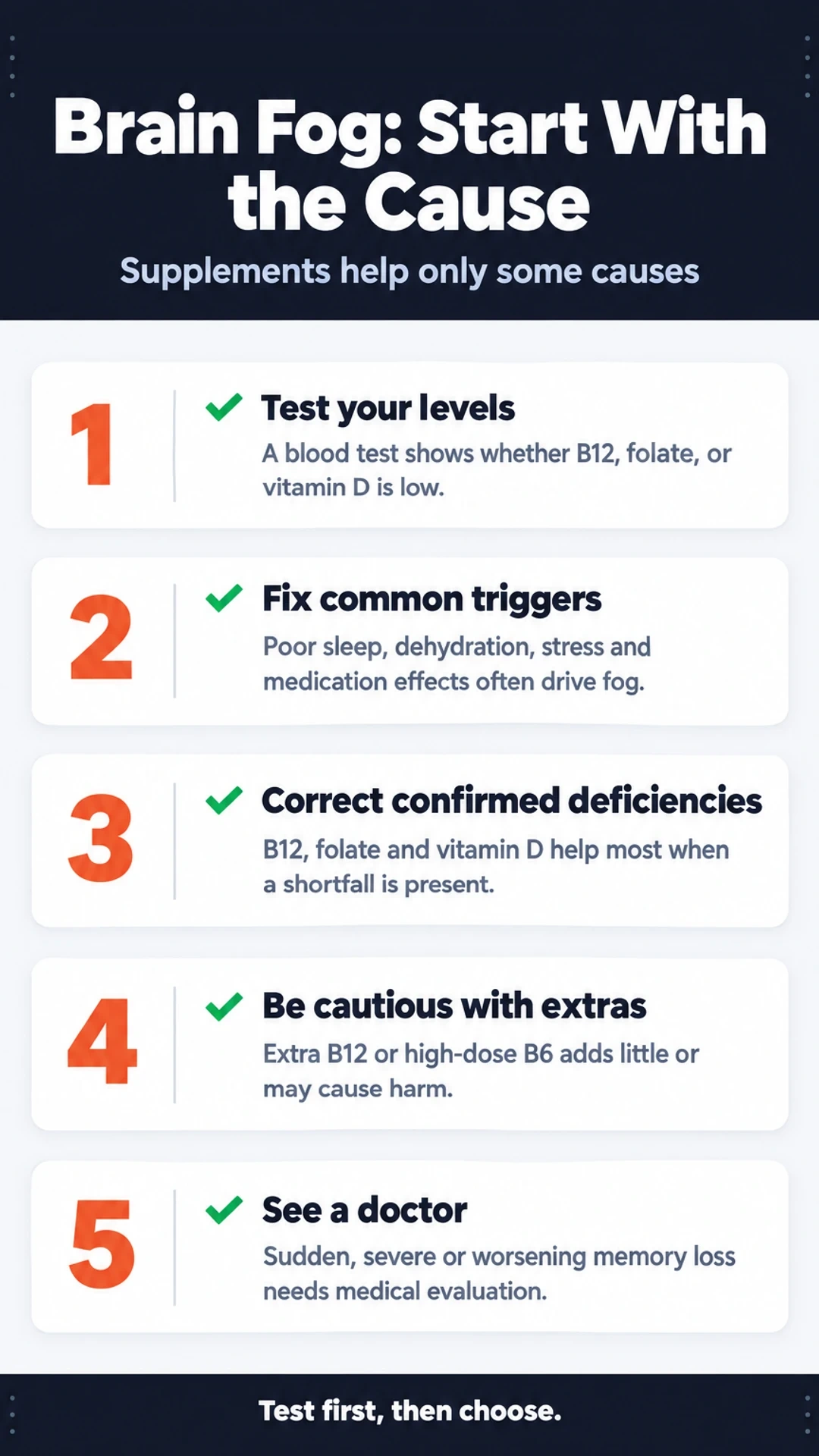
Nothing reliably clears brain fog within hours. Most fog has a cause you can act on: poor sleep, dehydration, a heavy meal, stress, or a medication side effect. Fixing the trigger, getting daylight and a short walk, and drinking water usually helps more than any supplement. If fog is sudden, new, or severe, see a doctor rather than trying to supplement it away.
Does B12 clear brain fog?
Only if your fog is linked to a B12 deficiency. Low B12 can cause tiredness, poor concentration, and memory trouble, and correcting it can improve those symptoms. In people with normal B12 levels, extra B12 is unlikely to sharpen thinking. A simple blood test can show whether you are low before you decide whether supplementing makes sense.
What to take for brain fog and memory loss?
Start by identifying the cause, since supplements address only some causes. Deficiencies in B12, folate, vitamin D, or iron are the most commonly suggested fixes when a blood test confirms them. Thyroid problems, sleep apnea, anemia, and medication effects also cause these symptoms. Memory loss that is progressive or worsening needs medical evaluation, not a supplement.
Do any brain supplements really work?
A few have evidence in specific groups. Correcting a true deficiency, such as B12 or vitamin D, reliably helps the symptoms it causes. For healthy adults, the evidence for most multi-ingredient brain formulas is thin or mixed, and trials are often small or short. Read the ingredient amounts and the studies behind them, not the marketing, before deciding.
Is there a best vitamin for brain fog and memory?
There is no single best option because brain fog has many causes. The right choice depends on what a blood test shows and on the ingredient's dose and evidence. Matching the supplement type to a confirmed need is more useful than ranking products by claims.
Wrapping up
We have covered 12 options for brain fog and memory, and each one addresses a different cause or has a different level of evidence.
Which one will you try first, or which one did we miss?
If you want to look more closely at one multi-ingredient option, Visit the official site to read the vendor's own description of Phytomem One's offer, including its plans and 60-day refund terms.