Best Supplement For MemoryBrain Vitamins for Studying: Which Options Have Research Behind Them
Brain Vitamins for Studying: Which Options Have Research Behind Them
Some links on this site are affiliate links: if you buy through one, the site may earn a commission at no extra cost to you. More about this.
If you are searching for brain vitamins for studying, you have probably noticed how crowded this space is. Bottles promise sharper recall and faster learning, and the ingredient lists read like a botany textbook. Sorting real research from marketing takes more effort than most people want to spend before an exam.
This page separates the nutrients that have some study evidence for learning or memory from those sold to students without that support. Here is what it covers:
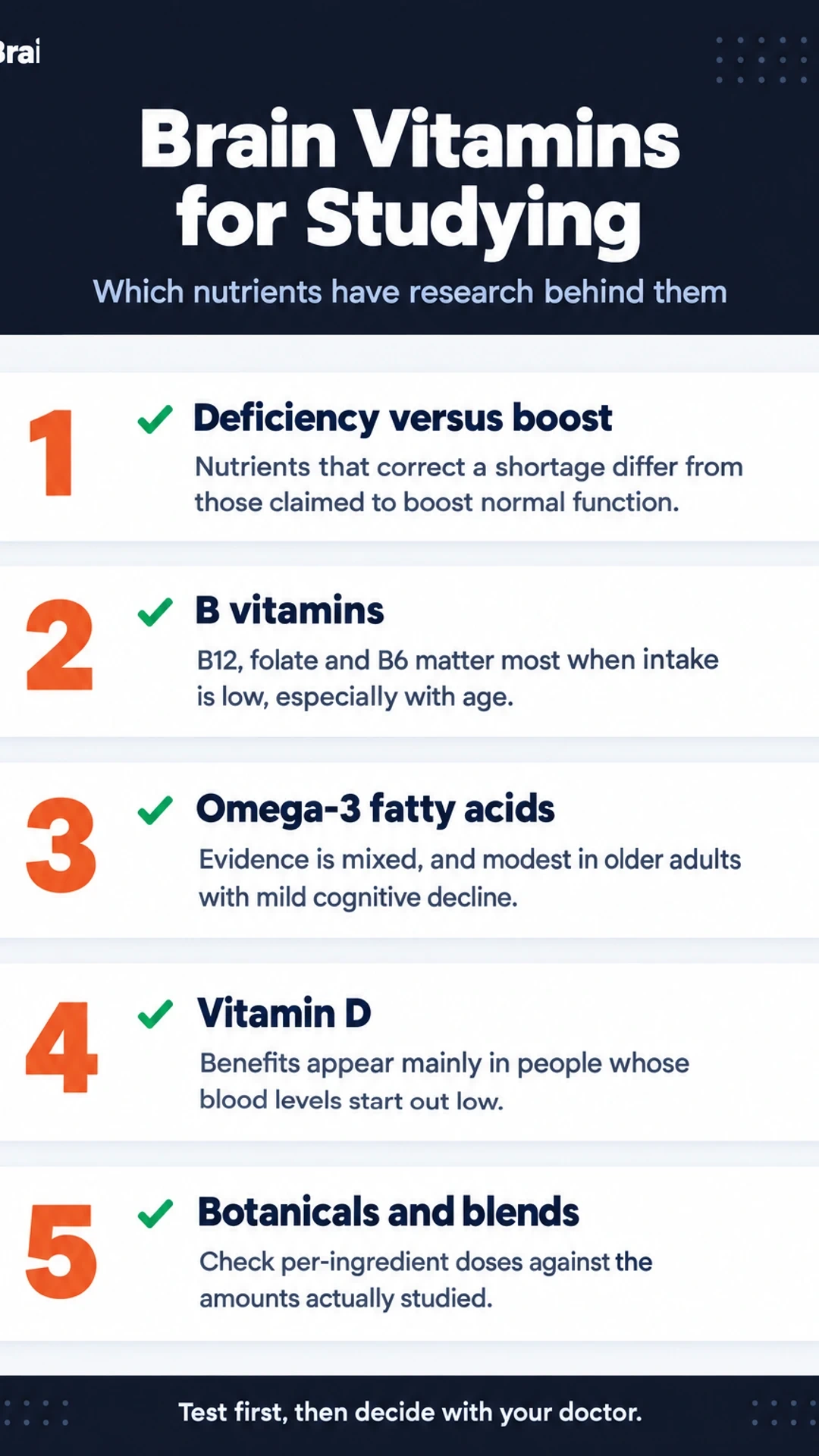
- Deficiency versus boost: why nutrients that correct a shortage differ from those claimed to improve normal function
- B vitamins: what the research on B12, folate and B6 does and does not show
- Omega-3 fatty acids: where the evidence is mixed, especially in older adults
- Botanical and proprietary blends: how to spot weak or absent support on a label
- Dose checks: how to compare a product's amount with the amounts studied
You will leave with a practical way to judge any brain supplement before you buy it, including the Phytomem One sales page, which lists ingredients such as saffron extract and berberine HCl.
What Counts as Research-Backed for Studying
Before you compare any brain supplement, it helps to know which kind of evidence you are looking at. The same nutrient can look impressive or useless depending on the study design behind it. Three types of evidence come up most often:
- Randomized controlled trials in healthy people. Participants are assigned to the supplement or a placebo, and outcomes are measured on a defined cognitive task. This is the strongest design for showing a benefit in someone who is already well nourished.
- Observational links. These track what people eat or take and how they perform over time. They can suggest an association, but they cannot separate the nutrient from everything else that differs between the groups.
- Trials in people with deficiency. When someone is short of a vitamin, correcting it often improves function. That result is real, but it describes repletion, not enhancement.
A nutrient helping a deficient person does not mean it helps a well-nourished student. If your intake is already adequate, your body has little room to gain from more, and extra doses rarely sharpen anything.
Also check who was studied and what was measured. Most memory-focused trials enroll older adults, often with early cognitive decline, and they tend to measure narrow tasks such as word recall or processing speed. Those outcomes do not translate directly into exam performance or the ability to learn new material in a course. Treat that gap as the default until a study shows otherwise.
B Vitamins: B12, Folate and B6
The B vitamins are the group most often cited for brain health, and they are also the group where the evidence is most uneven. The clearest case for benefit comes from deficiency. B12, folate and B6 are cofactors in the one-carbon cycle that converts homocysteine back to methionine. When these nutrients run low, homocysteine can build up, and elevated homocysteine has been associated with cognitive decline in observational research. Deficiency is more common with age, reduced stomach acid, and diets low in animal foods or in greens, so older readers and those eating restrictively are the people most likely to have a real gap to fill.
For someone who is already replete, supplementing is unlikely to sharpen memory or study performance in any measurable way. Trials in well-nourished adults have given inconsistent results, and some of the positive findings come from people who were deficient at the start. If you are not deficient, do not expect a noticeable change.
Before you supplement, check your B12 status. A serum B12 test, and often methylmalonic acid, will tell you whether a deficiency exists. This matters because high-dose folic acid can correct the anaemia of B12 deficiency while the neurological damage continues silently. Folate should not be taken in large amounts without knowing your B12 level.
- Check B12 (and ideally folate) before starting a B-complex.
- Treat a confirmed deficiency under medical supervision.
- Avoid high-dose folate as a general memory aid.
Omega-3 Fatty Acids and Vitamin D
Most of the brain supplements aimed at students rely on two nutrients that have been studied for years: the omega-3 fats DHA and EPA, and vitamin D. The evidence for each is quite different, so it is worth looking at them separately.
Does omega-3 help memory and learning?
DHA is a major structural fat in the brain, and EPA is involved in inflammatory signalling. The clinical trial picture is mixed. Trials in older adults with mild cognitive decline have produced inconsistent results, with some showing small benefits on memory tests and others showing none. Trials in healthy younger adults have generally found little or no measurable effect on learning or recall. Where benefits do appear, they tend to be modest and most visible in people who were eating very little fish to begin with. That point is worth remembering when you read headline findings.
For a student with an adequate diet, the research does not support expecting a noticeable change in study performance from omega-3 alone. For an older adult, the question is more open. A dietary review with your doctor is a sensible first step before adding fish oil.
What does the vitamin D evidence actually show?
Much of the vitamin D and memory literature is observational. People with higher vitamin D levels often score better on cognitive tests, but observational studies cannot show that the vitamin caused the difference. Low vitamin D can also reflect poor health, low activity or less time outdoors, all of which affect cognition independently.
The intervention trials are more mixed. Benefits tend to show up in people who started with clearly low blood levels, and they are much weaker in people who were already sufficient. That is why a general "brain" label on a vitamin D product tells you little.
Should you test before taking vitamin D?
Yes. A simple blood test measuring 25-hydroxyvitamin D tells you whether you are deficient, and that result is a far better basis for a decision than any marketing claim. If your level is low, your doctor can recommend a dose. If it is adequate, extra vitamin D is unlikely to change your memory and may not be needed at all.
- Ask for a 25-hydroxyvitamin D test if you suspect low intake or limited sun exposure.
- Treat a result in the normal range as a reason not to add a high-dose product.
- Check with a clinician before combining vitamin D, omega-3s or other supplements with prescription medicines.
Choline, Botanicals and Proprietary Brain Blends
Choline is a useful place to start because it has a real biological role. It is a precursor to acetylcholine, a neurotransmitter involved in attention and memory, and it is also needed to build cell membranes. Most adults get some choline from eggs, meat, fish and legumes, and the body makes a small amount itself. The question for a student is whether adding more changes memory in someone who already has enough. The evidence for that in healthy adults is limited. Some trials have looked at choline and cognition, but results are mixed, and most do not show a clear benefit for memory in people without a deficiency. Treat choline supplements as a nutrition question, not a studying shortcut.
Botanical extracts sold for focus present a different problem. Ginkgo, bacopa, rhodiola and similar products have been studied, but the trials are often small, short, or conducted in older or clinical populations rather than healthy students. Some were funded by the manufacturers. Where that is known, read the results with that in mind. A short-term effect on a lab task does not tell you much about exam performance weeks later.
Proprietary blends make the picture harder still. When a label lists a total blend weight with no amount per ingredient, you cannot check whether any studied dose is present. You might be taking a clinically tested amount of one ingredient, or a few milligrams of it alongside much larger amounts of others. Before you buy, look for per-ingredient doses and compare them with the amounts used in the trials you are relying on.
Vendor claims deserve the same scrutiny. Phytomem One is sold through its own sales page, which describes it as a 10-in-1 formula for mental clarity and recall and lists ingredients including saffron extract, berberine HCl, Ceylon cinnamon bark and corosolic acid. These are the vendor's claims, not independently tested results, and the page does not show per-ingredient amounts you could compare against published research. Check any product, including this one, against the same criteria: studied doses, study quality, and whether the label lets you verify what you are buying.
Evidence for Common Brain Supplement Types
Swipe sideways to see more columns.
| Option | Pros | Cons |
|---|---|---|
| Choline | Biological role in memory | Mixed trial results in healthy adults |
| Botanical extracts | Some have been studied | Small, short or manufacturer-funded trials |
| Proprietary blends | Can list many ingredients | Per-ingredient amounts often hidden |
| Vendor-named formulas | Ingredient lists are shown | Claims not independently tested |
How to Compare Options Side by Side
Most brain vitamin labels look similar at a glance, so it helps to run every product through the same short set of checks before you look at price. The method below works for any option, including the ones covered elsewhere on this site.
Start with the ingredient panel. Each named ingredient should appear with its amount, not just as a line in a proprietary blend. Then ask whether that amount matches the range used in the published trials for that ingredient. A dose far below the studied range is a weak signal, and a dose far above it can raise safety questions. Note whether the product is a standard multivitamin, a single nutrient, or a botanical extract, since the evidence differs sharply between them.
Check the quality and safety signals:
- Third-party testing from an independent lab, with the certificate or batch results available to you
- Clear interaction warnings, especially if you take anticoagulants, diabetes medication, or antidepressants
- Named sources for any extract, so you know what plant part and standardization were used
Work out cost per effective dose. A cheap bottle can cost more per day than a pricier one if its doses are too small to matter. Divide the price by the number of days' supply at the studied amount, not the label serving.
Watch for red flags:
- Claims of sharper memory or better grades, which no supplement has been shown to deliver reliably in healthy adults
- Undisclosed blends that hide the amounts of expensive or stimulating ingredients
- Promises of results within days
These checks won't tell you whether a product works. They tell you whether its claims are worth testing against the research.
Realistic Expectations and When to See a Doctor
Before you compare labels, it helps to be clear about what any capsule can realistically do for studying. Sleep, spaced practice and sustained effort affect exam results far more than any vitamin does. If you are short on sleep, cramming the night before, or studying in long unbroken blocks with no retrieval practice, no brain supplement will change that picture. Treat a supplement as a possible small addition to a sound routine, not a substitute for one.
Even among ingredients with some learning or memory research, most of the trials are small, short, or mixed in their results. Read a study's population, dose and duration before you give its findings much weight. My rule for judging a product is simple: a claim that sounds like a clinical result but has no named trial behind it is a marketing claim, whatever the packaging says.
When to see a doctor
Talk to a medical professional if you notice any of the following:
- Memory problems that are new, getting worse, or affecting your work, study or daily routine
- Confusion about dates, places or familiar tasks
- Changes in mood, sleep or personality alongside forgetfulness
- Any supplement you are considering alongside prescription medications, including blood thinners, diabetes medicines and blood pressure drugs
Memory changes can have treatable causes such as thyroid problems, low B12, medication side effects, sleep disorders or depression. A supplement will not address those, and delaying a proper assessment can cost you time.
For deeper reading, see our guides on focus and concentration, brain fog, and safety checks for older adults.
Frequently asked questions
Which vitamin is best for studying?
No single vitamin has strong evidence for improving learning in people who are already getting enough. Vitamin B12 and folate matter most when a deficiency is present, and fixing a deficiency can improve cognition. For well-nourished students, the research on vitamins alone is thin, so a balanced diet and adequate sleep usually do more for study performance than any one supplement.
How can I boost my brain to study?
The best-supported levers are sleep, regular aerobic exercise, and spaced practice with retrieval, such as self-testing rather than rereading. Caffeine in moderate amounts can help alertness for a session. Supplements are a much smaller factor, and most of the claimed brain boosters have little controlled-trial evidence in healthy young adults.
Which vitamins are good for brain memory?
Vitamins B6, B12, and folate are linked to normal nerve and brain function, and deficiency is associated with memory complaints. Vitamin D status has been studied in relation to cognition, though results are mixed. If you have no deficiency, supplementing these is unlikely to sharpen memory further. A blood test is the practical way to find out whether you are short on any of them.
How can I sharpen my memory?
Memory responds most reliably to seven or more hours of sleep, regular exercise, and active recall methods like flashcards and practice questions. Managing blood pressure and blood sugar also supports long-term cognitive health. Treat supplements as a secondary consideration, and check whether any product you are considering has human trial data for the specific ingredients in it.
Do brain vitamins for studying actually work?
For most healthy students, the evidence that vitamins improve study performance is weak. Vitamins can help when a deficiency exists, which is why identifying one matters more than buying a general brain formula. Ask whether the product's ingredients were tested in people, at the doses used, and in people similar to you.
Wrapping up
Nutrients with a clear link to memory, such as B12, folate, and B6, matter mainly when a deficiency is present. For a student with adequate nutrition, sleep, exercise, and good study habits remain the stronger levers, and most marketed brain formulas lack solid human trial data for learning outcomes. Have you tried a supplement for studying, and did you notice a difference? Share your experience in the comments.