Best Supplement For MemoryMemory Supplements for Adults: A Side-by-Side Ingredient Review
Memory Supplements for Adults: A Side-by-Side Ingredient Review
Some links on this site are affiliate links: if you buy through one, the site may earn a commission at no extra cost to you. More about this.
Based on the product's documentation and what users report, not our own testing. Last checked: 14 November 2026.
You have probably already seen the same handful of blends repeated across product pages, each promising sharper recall with a long list of botanicals. The labels rarely say how much of each ingredient they contain, which makes it hard to judge whether a given dose resembles anything studied.
This page takes a different approach. Based on the product's documentation and what users report, not our own testing, we look at one specific option, Phytomem One, and set its 10 named ingredients beside the research status and typical doses for each.
We explain how the picks were chosen, what the vendor's sales page says, and where the claims are supported and where they are not. Along the way, you will see which ingredients have reasonable human data and which rest mainly on early or animal studies.
What Memory Supplements Contain and How They Are Built
Most adult memory supplements fall into three ingredient families, and the way a product groups them tells you a lot about what it is trying to do.
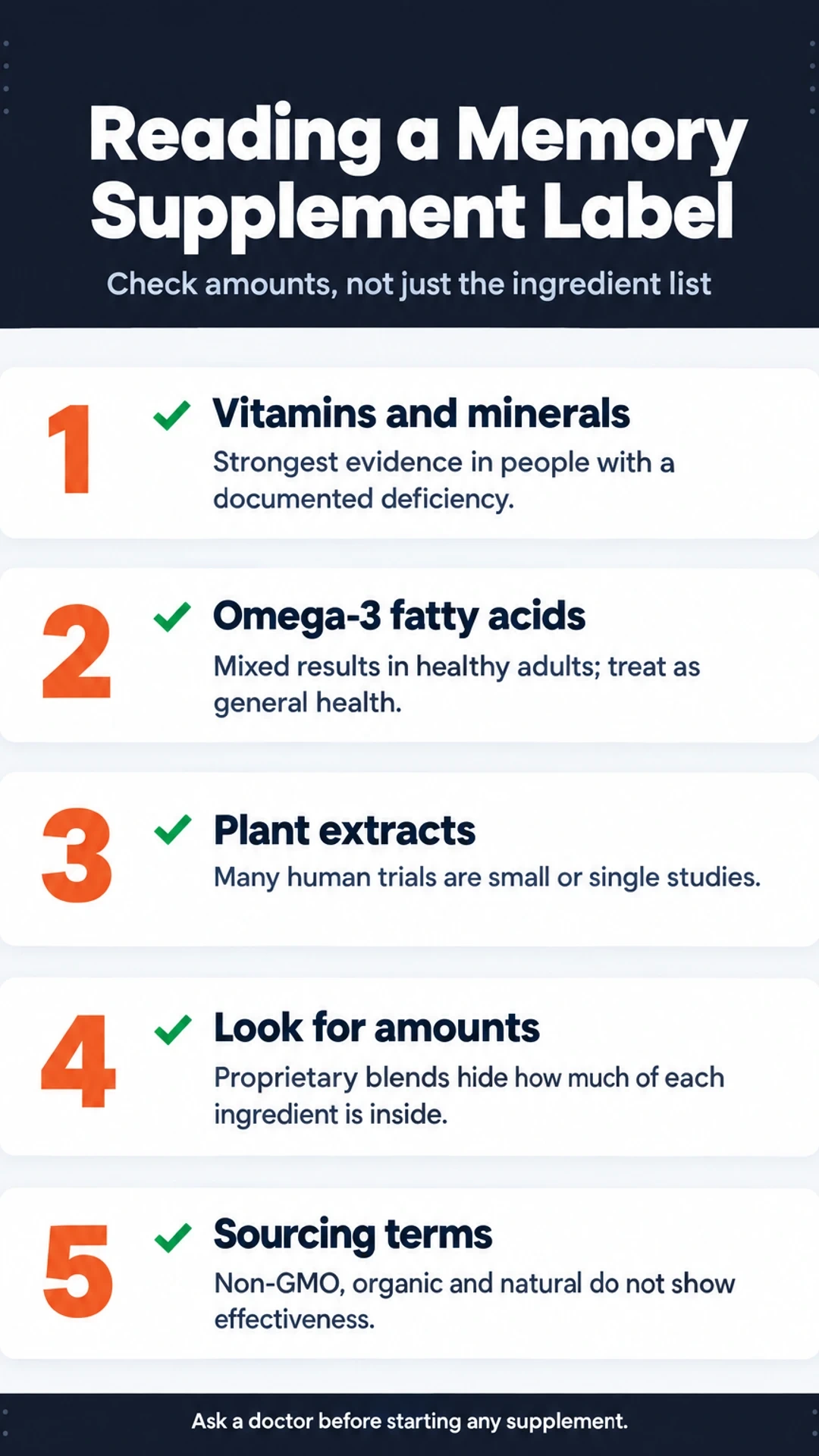
- Vitamins and minerals. B vitamins (especially B6, B12 and folate), vitamin D, and minerals such as magnesium and zinc. These correct documented deficiencies, and the evidence for their effect on memory is strongest in people who are low in them to begin with.
- Omega-3 fatty acids. Mainly DHA and EPA from fish oil or algae. Research on memory in healthy adults is mixed, so treat these as a general-health ingredient rather than a memory-specific one.
- Plant extracts and other botanicals. Ginkgo, bacopa, saffron, curcumin and similar extracts. Human trials vary widely in size, duration and dose, and many findings come from a single small study.
Single-ingredient products let you check one dose against one trial. Multi-ingredient formulas are harder to judge. Each ingredient may be present at a dose far below what was studied, and a proprietary blend lists a combined weight without showing how much of each component is inside. That makes it impossible to compare the formula with the research behind any single part.
The ingredient count is a poor guide to quality. A formula listing ten ingredients may dose most of them at a token level, while a product with three well-dosed, well-studied ingredients may do more. Check the amount of each ingredient, not the length of the list.
Common Ingredient Families at a Glance
Swipe sideways to see more columns.
| Ingredient family | Where the evidence is strongest | Main limitation |
|---|---|---|
| Vitamins and minerals | People with a documented deficiency | Little benefit in people with adequate levels |
| Omega-3 fatty acids | Not stated | Mixed results in healthy adults |
| Plant extracts and botanicals | Not stated | Many trials are small or single studies |
Side-by-Side Ingredient Review: Research Status and Typical Doses
Based on the product's documentation and what users report, not our own testing, here is how the main ingredients compare. The quick version: the vitamins have the strongest evidence, and it is mostly tied to correcting a deficiency rather than boosting memory in people who already have enough.
Core nutrients
- B vitamins (B6, B12, folate): The clearest signal is in people with low levels, where correcting a deficiency can help cognition. In adults with adequate levels, trials have generally not shown memory gains. Typical supplement doses sit near the recommended daily amounts, and older adults are the group most likely to be low in B12.
- Vitamin D: Evidence is mixed. Benefit is most documented in people who are deficient. Typical studied doses for vitamins vary, and the fact sheet for Phytomem One gives only one figure: the usual dose is one capsule daily with food. The fact sheet does not list the ingredient amounts, and one reviewer found that amounts are not disclosed. A blood test is one way to learn whether a vitamin intake is needed, and a doctor can advise on that.
- Vitamin E: Some older-adult data suggest a modest effect on decline, but the doses used in trials are high and carry bleeding risk when combined with anticoagulants. Dose is not a safe thing to guess at.
- Vitamin C: Associated with cognition mainly through observational links to dietary intake. No reliable supplement dose for memory has been established.
- Omega-3 fatty acids (DHA/EPA): Modest or inconsistent effects in people without deficiency or cognitive impairment. Studied doses are often around 1 g of combined EPA and DHA daily, but a trustworthy memory dose is not established.
Less common ingredients
- Berberine: Mostly studied for blood sugar and metabolic markers. Human cognitive research is limited and early. A dose for memory is not known.
- Saffron extract: A few small human trials report effects on mood and memory. Evidence is preliminary, and a trustworthy memory dose is not known.
- Fucoxanthin: Almost all data come from animal and cell work. Human memory research is very limited.
- Ceylon cinnamon: Studied mainly for glucose control. Cognitive evidence is thin, and no memory dose is established.
- Banaba leaf (corosolic acid): Studied for blood sugar. There is no solid human memory evidence, and no memory dose is known.
- Kudzu flower extract: Little human cognitive research exists. No trustworthy dose is known.
- Morosil: Mostly lab and small-scale work on cholesterol and metabolism. Human memory data are essentially absent.
The Phytomem One sales page lists several of these less common ingredients, including berberine, saffron, fucoxanthin, Ceylon cinnamon, banaba leaf, kudzu flower and Morosil. The ingredient amounts are not disclosed, one reviewer found, so you cannot compare them against the doses above. The page's usual dose is one capsule daily with food, but that is the only dosing detail given.
Reading the Label: Amounts, Proprietary Blends and Sourcing Claims
Start with the amounts. A label that lists every ingredient with a milligram figure lets you check each one against the doses used in published studies. A label that lists ingredients without amounts, or groups several under one total weight, makes that check impossible. Phytomem One is one example: according to the sales page, it contains 10 ingredients, but the amounts are not disclosed, and one reviewer found the same.
When amounts are missing, treat the ingredient list as a menu rather than a dosing plan. Ask whether the named ingredient has human trial data at a comparable dose, and whether that data concerns memory, cognitive function, or something else entirely.
Next, read the sourcing terms with care. These are the words that most often sit on a label without telling you much about effectiveness:
- Non-GMO describes how the crop was grown, not whether the compound works.
- Organic describes farming and handling standards, not potency or clinical benefit.
- Natural has no consistent regulatory definition for supplements, so it says little about what is inside.
- Stimulant-free tells you the product lacks caffeine-type stimulants, which is useful for sleep and anxiety, but does not establish that the remaining ingredients help memory.
Finally, separate attributed claims from tested results. Claims that come from the company itself are marked as its own. The sales page states that the product contains 10 ingredients and is non-GMO and stimulant-free, and those are the company's statements rather than independent findings. A claim that names an independent study, with a journal and a dose, is a different kind of evidence. If a page presents results without naming who measured them, treat them as unverified.
Label Terms and What They Tell You
Swipe sideways to see more columns.
| Label term | What it describes | What it does not show |
|---|---|---|
| Non-GMO | How the crop was grown | Whether the compound works |
| Organic | Farming and handling standards | Potency or clinical benefit |
| Natural | No consistent supplement definition | What is inside or how much |
| Stimulant-free | Lack of caffeine-type stimulants | Benefit of the remaining ingredients |
Safety Checks Before You Buy, Especially for Older Adults
The Phytomem One sales page lists berberine HCl, Ceylon cinnamon bark, corosolic acid from banaba leaf, and kudzu flower extract among its ingredients. Several of these have known effects on blood sugar, and banaba and kudzu are discussed in the literature for possible effects on blood glucose. If you take insulin, a sulfonylurea, or another glucose-lowering drug, the combination can push blood sugar lower than intended. The same caution applies to anything that may affect clotting, so check with your doctor or pharmacist before adding this product to a regimen that includes a blood thinner such as warfarin or a daily aspirin.
Who should speak with a clinician first?
Talk to your doctor or pharmacist before starting if any of the following applies:
- You take prescription medication of any kind, including diabetes drugs or anticoagulants
- You are pregnant, trying to conceive, or breastfeeding
- You have diabetes, liver or kidney disease, a bleeding disorder, or an upcoming surgery
- You are already being assessed for memory changes, since supplements can mask or delay a proper workup
The fact sheet records that the company itself advises checking with a doctor if you have safety concerns.
Why the age limit and terms matter
The website's terms limit use to adults aged 18 and over, and to personal, noncommercial use. Those terms are the only age guidance we found, so the product is not specifically labelled for older adults. The terms also say the company may change or withdraw the site without notice and is not liable if it is unavailable, so save the product details and ingredient list when you buy. Read the ingredient list on the bottle you receive, not only the sales page, because the page does not disclose individual ingredient amounts.
What Lifestyle Factors Do Alongside Supplements
Before you judge any memory supplement, look at what else is going on. The reviews we drew on for Phytomem One, including two independent sources, repeatedly note that results depend on consistency, nutrition, sleep, physical activity, stress and general lifestyle. A capsule taken on top of poor sleep and a sedentary week is unlikely to show much, whatever its ingredients.
Things to keep steady alongside any product:
- Sleep at a regular time, and treat short or broken sleep as a real variable
- Regular aerobic activity, which is the lifestyle factor most consistently linked to brain health
- A diet with enough protein, vegetables, and omega-3 sources
- Some control over chronic stress and blood pressure
Can food supply the same nutrients?
For most adults, a varied diet supplies vitamins such as B12, folate and D in useful amounts. Where a product lists several vitamins at high doses, ask whether your diet already covers them. A blood test, such as B12 or vitamin D levels, or a diet review with a dietitian, makes sense if you have restricted eating, a history of malabsorption, or symptoms you want to explain. Many ingredients in these formulas, such as berberine or banaba extract, have no dietary equivalent, so food comparison only helps with the vitamin and mineral content.
What is a fair trial, and what counts as a change?
The Phytomem One sales page offers a 60-day period, and the vendor says it is designed to work gradually. Results depend on consistency, nutrition, sleep, activity, stress and lifestyle. The documentation does not give a timeframe for judging results, and independent sources say that many users report better focus, clarity and memory after several weeks. Track something specific, such as recall of names or how quickly you finish a task, rather than a general feeling. Note any change to sleep or activity during that window, since it can mask or mimic a supplement effect. Report to a doctor any new side effects, and do not treat a supplement as a substitute for assessment if memory problems are worsening.
Questions to Answer Before Choosing a Memory Supplement
Start with the ingredient label, not the marketing. For each ingredient, ask whether there are human trials at the dose used, not just cell or animal work. An ingredient can be well studied at one dose and barely studied at another. If the label lists a proprietary blend without per-ingredient amounts, you cannot judge whether any ingredient reached a dose that was actually tested. Phytomem One is one example: its sales page names ten ingredients, but one reviewer found the amounts are not disclosed, so you cannot check the doses against the trial literature.
Next, check the commercial terms:
- The refund window and the process. Phytomem One advertises a 60-day money-back guarantee and says a refund is requested by emailing the team.
- Where it is sold. The vendor says it is sold only on its own page. Checkout runs through ClickBank.
- Whether the plan is a subscription. Phytomem One is described as a one-time purchase.
- Shipping cost. The STARTER plan adds a shipping fee; the ULTIMATE and ADVANCED plans include free US shipping.
One reviewer warned that imitation products are sold online, so buying from the official site matters.
Do these products work? The honest answer is that evidence for most single memory ingredients is modest and mixed, and no product sales page establishes benefit. Results also depend on sleep, activity, nutrition, stress and consistency, which reviewers consistently point to.
Do vitamins alone prevent memory decline? No good evidence shows that. Correcting a real deficiency can matter, but general supplementation has not been shown to prevent decline in people who are not deficient.
Where can you find trustworthy information? Start with your doctor or pharmacist, then look at systematic reviews and national health agencies rather than sales pages or video reviews. Phytomem One's own FAQ advises checking with a doctor about safety, and that applies to any supplement you take alongside medication.
Frequently asked questions
What do Japanese eat to prevent dementia?
No single Japanese food prevents dementia. Observational studies of older Japanese adults have linked diets rich in fish, soy, vegetables, seaweed and green tea with lower dementia risk, but these are associations, not proof of cause. Much of the research also reflects overall eating patterns rather than individual foods, so no specific dish should be treated as a shield against cognitive decline.
Does Prevagen or Neuriva actually work?
The evidence for both is limited and mixed. Prevagen's main ingredient, apoaequorin, has been studied, but independent reviews have not confirmed the memory benefits its marketing describes, and the US FTC took action against its claims. Neuriva has a few small trials, mostly industry-funded, that show modest effects on certain cognitive measures in specific groups. Neither has shown clear, meaningful memory improvement in typical adults.
Can a supplement cut dementia risk?
Claims like this usually come from single observational studies, subgroup analyses or misreported results. Large randomized trials of B vitamins and vitamin D have not shown a meaningful reduction in dementia, so anyone seeing that figure should check the original study and its design before accepting it.
What does Mayo Clinic recommend for memory?
Mayo Clinic's guidance on memory centers on lifestyle: regular physical activity, good sleep, managing blood pressure, blood sugar and cholesterol, limiting alcohol, staying socially and mentally active, and treating hearing loss and depression. It advises talking to a doctor about memory changes, since many causes are treatable, and it does not present supplements as a reliable fix for memory problems.
Are memory supplements safe for older adults?
Many supplements interact with prescription drugs, including blood thinners and diabetes medications, and some ingredients carry real risks at high doses. Older adults should review any product with a doctor or pharmacist before starting it. Supplements are not regulated for effectiveness before sale in the way prescription drugs are, so the label alone does not establish safety for any individual.
Wrapping up
Memory supplements for adults rarely have strong, independent evidence behind their claims, and the best-studied benefits tend to come from sleep, activity, blood pressure control and treating hearing loss. Read ingredient lists against the research and doses actually tested, not the marketing. Which ingredients have you looked at, and what did the research show for you? Share your comments below.